转录相互作用
- 1 网络模体(结构单元模式)
- 2 最简单的网络模体:负自身调节模块
- 3 模体的作用及稳定
第一部分
随机化网络和调控网络比较,找出统计学显著性有意义的模式,即为网络模体。
生物体碱基序列的突变会为网络增添或者减少边的个数。
经典的随机网络模型为 Erdos-Renyi(ER)模型,与调控网络的边E和节点数N相同,每一个可能的边的位置被占用的概率为$p=\frac{E}{N(N-1)+N}$,即$\frac{E}{N^2}$。
转录相互作用
第一部分
随机化网络和调控网络比较,找出统计学显著性有意义的模式,即为网络模体。
生物体碱基序列的突变会为网络增添或者减少边的个数。
经典的随机网络模型为 Erdos-Renyi(ER)模型,与调控网络的边E和节点数N相同,每一个可能的边的位置被占用的概率为$p=\frac{E}{N(N-1)+N}$,即$\frac{E}{N^2}$。
%matplotlib inline
对于上述命令行的疑问解答
ipython中有一类型的magic function,属于内嵌函数,用于绘图,pycharm不支持,但是在ipython(jupyter notebook)中使用,可以省略plt.show()步骤,在当前行一下使用。
correct answers
in every example in our data set, we are told what is the “correct answer” that we would have quite liked the algorithms have predicted on that example, such as the prices of the house or whether the tumor is malignant or benign.
Regression:预测连续性变量的输出,predict continuous valued output(price)
eg: sell house,breast cancer
Classification: discrete valued output(0 or 1) eg:breast cancer: use tumor size and age to predict malignant or benign
inifinite number of features
SVM: allow computer to deal with an infinite number of features to aviode memory error.
不知道分类或者聚类的结果
clustering
cocktail party problem

使用octave的优势。
m: number of training examples
$x^s$: “input” variable/feature
$y^s$: “output” variable/“target” variable
cost function(代价函数)
Hypothesis: $h^{\theta}(x)=\theta_0+\theta_1x$
Cost function: $J({\theta}0,{\theta}_1)={\frac{1}{2m}}{\times}{\sum(h{\theta_0}(X^{(i)})-y^{(i)})^2}$
contour plot
找到$\theta0$,$\theta1$,使得J最小。
目的:找到$\theta_0$,$\theta_1$,使得J最小。

从不同的角度出发,会获得不同的局部最优解。

梯度下降时要求同时更新$\theta_0$,$\theta_1$,其中$\alpha$后面的一项是J($\theta_0$,$\theta_1$),在$\theta_0$,$\theta_1$切线的斜率。learninng rate $\alpha$:越大表示梯度下降越快。

当接近局部最小值的时候,梯度下降会自动减小步幅,所以不用一直减小$\alpha$。

梯度下降算法的推导

将线性回归的J 函数带入梯度下降的公式,可以推导出$\theta_0$,$\theta_1$,这时候平方和求导抵消,因此没有平方。

凸函数只有全局最优解,没有局部最优解
Batch gradient descent algorithm
batch: each step of gradient descent uses all the training examples
matrix: rectangular array of numbers
dimension of matrix: number of rows X number of columns
vector: An nX1 matrix
矩阵加减以及和一个常量乘除,和数字的运算一致,逐个元素相加相减。

解方程的矩阵代入


解方程的矩阵代入

矩阵相乘没有交换率(communitive)
矩阵相乘符合结合律(asscociation)
identify matrix: $A I =I A =A$,I即为 单位矩阵,维数通常隐藏的。
倒数矩阵


多元回归的函数


Feature scaling
idea: make sure features are on a similar scale
如果两个变量的范围量级差异很大,会造成梯度函数的等高图变成椭圆形,学习时,振荡范围很小,导致学习时间巨长。一般性控制全部变量的取值范围在-3~3区间即可


mean normalization:X=(x-u)/(max-min)
特征缩放不用非常精确,因为目的只是让梯度下降更快一点。
对于线性回归,当学习率足够小,每一次迭代后J($\theta$)会一直递减,、。
学习率过大:J($\theta$)上升或者波动,不收敛。
学习率过小:收敛速度很慢。

在选择学习率的时候,需要打印J($\theta$)函数。tricky:可以以3倍的速度进行选择,尝试最大值和最小值后,在最大值附近选取一个合适的学习率。(…0.001,0.003,0.01,0.03,0.1,0.3,1…)
可以选择多种函数来fit the curve
J($\theta$)在$\theta$的导数=0
$\theta$=pinv(X’X)X’y X’倒置。pinv求倒数
对于正规方程,不用feature scaling.


$\theta$=pinv(X’X)X’y 如果X’X不能求倒数,即为singular/degenerate 矩阵。
Octave:pinv()和inv()都是求倒数,但是pinv能够求解奇异矩阵的倒数,是pseudo inv.
X’X不能求倒数的可能原因:
回归不适合分类。
Classfication: y=0 or y=1
h(x) can be >1 or <1
logistic regression: 0<=h(x)<=1 用于classification。
want 0<=h(x)<=1
sigmoid function = logistic function


hθ(x)=g(θTx)
z=θTx
g(z)=1/(1+e−z)
hθ(x)=P(y=1|x;θ)=1−P(y=0|x;θ)P(y=0|x;θ)+P(y=1|x;θ)=1
y=1, θTx>=0;
y=0, θTx<0

Non-linear decision boundaries


Unfit, high bias: too sample or use too few features
Overfiting, high variance: a compllicated function that creates alot of unnecessary curves and angles unrelated to the data
多幂函数的产生,用力拟合,cost function 很小,但是不具备广泛的拟合。
adressing overfiting,feature 太多,并且训练集太少会导致overfiting
为了避免过度拟合(往往由高阶幂造成),在cost function上加一个参数项$\lambda$ $\theta$,如果参数项越大,训练的目的是使cost function 小,所以会设置$\lambda$非常大,$\theta$约等于0,就能减少cost function。
$\theta0$,$\theta1$,$\theta2$…$\theta$n越小,拟合的曲线越光滑。
正则化的项,是为了平衡拟合训练的目的以及近可能保持低的$\theta$值


$a^{(j)i}$=”activation” of unit i in layer
$Θ^{(j)}$=matrix of weights controlling function mapping from layer j to layer j+1
dim($Θ^{(j)}$)=$S_{j+1}$ *$S_{j}+1$

为了使用优化函数,要求变量是向量,而神经网络中$\theta$是矩阵而非向量,因此可以卷开为thetaVec,梯度也需要卷开。


目的:减少代码错误
初始化theta参数,需要随机取值,否则如果theta1=theta 2 ,会造成symmetry breaking。

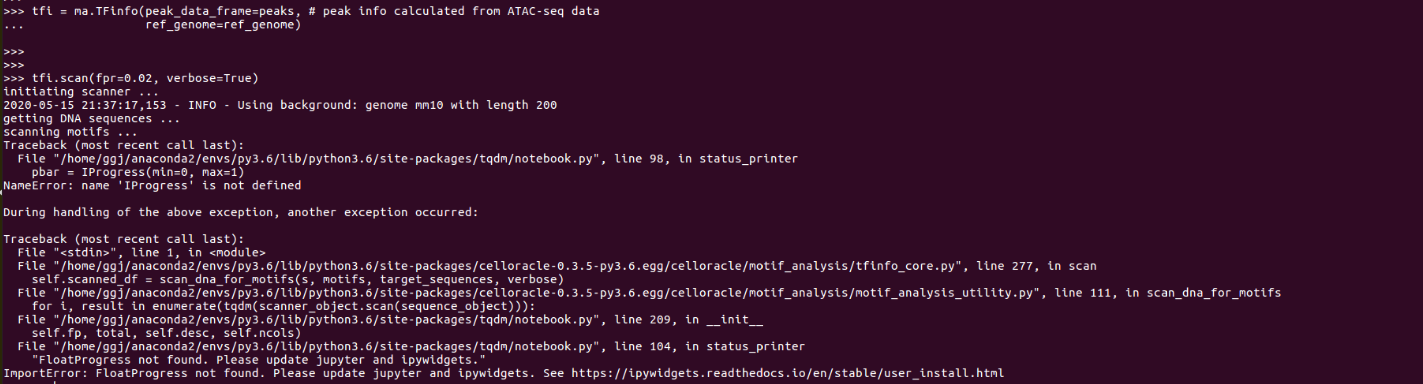
使用CellOracle的时候,报错“InProgress is not defined”
网上给出的解决方式是在base环境(安装jupyter)中安装widgetsnbextension,在使用环境安装ipywidgets,具体可以见网址 https://ipywidgets.readthedocs.io/en/stable/user_install.html ,但是这个方法对我不适应。
实测有效
使用jupyter notebook 来跑程序,但是出现kernel keep die的情况,那么需要卸载ipykernel和ipython,然后重新,并且安装nb_conda(为了是jupter识别该conda环境),参考网址:https://github.com/tqdm/tqdm/issues/872
1 | conda remove ipykernel |
分析流程
目的: identify accessible promoter/enhancer DNA regions
scATAC-seq: proximal and distal promoter/enhancer genome sequences(co-accessible socres and TSS infomation)
bulk ATCC seq: proximal promoter/enhancer genome sequences
输入:ATAC的结果,以bed file的形式
输出:peaks,gene_short_name,co-access scores(bulk无)
目的: 扫描基因的调控序列,获取TF list
输出:矩阵,行peaks name and target gene name, 列TF names
科学网 周涛 2012年关于复杂网络的入门书籍和review 介绍
周涛 2017年关于复杂网络的review 推荐
CSDN 博客 复杂网络入门笔记
网络参数的解读
Stress centrality:构建最短路径经过的数量
Betweenness centrality:
degree centrality is the most straightforward measure, reporting how many edges are connected to a node (in this case, how many genes a given TF connects to)
betweenness centrality and eigenvector centrality; genes with high betweenness are essential for the transfer of information within a network, whereas genes with high eigenvector centrality scores have the most substantial influence in terms of their connections to other well-connected genes
搭建博客参考网址:https://www.cnblogs.com/selier/p/9568165.html 或者http://stevenshi.me/2017/05/07/hexo-blog
theme-next 主题修改:http://theme-next.iissnan.com/getting-started.html
图库搭建:https://www.cnblogs.com/ly-2019/p/11828790.html
博客升级参考;https://www.jianshu.com/p/9f0e90cc32c2
1 | hexo new "文章标题" |
Welcome to Hexo! This is your very first post. Check documentation for more info. If you get any problems when using Hexo, you can find the answer in troubleshooting or you can ask me on GitHub.
1 | $ hexo new "My New Post" |
More info: Writing
1 | $ hexo server |
More info: Server
1 | $ hexo generate |
More info: Generating
1 | $ hexo deploy |
More info: Deployment